Best Aesthetics & Skin Clinic, London 2026

Medical

Cryotherapy

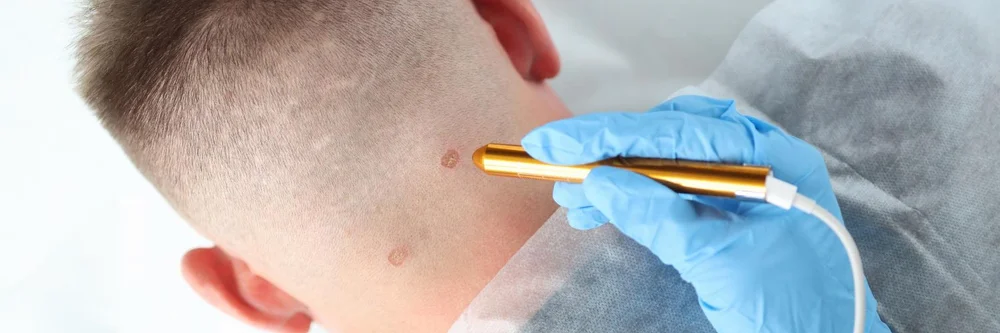
Quick, precise removal of skin tags, warts and other benign lesions, using a focused jet of extreme cold.

Cryotherapy for skin tags and benign lesions

At a glance

Treatment time

15 to 20 minutes

Anaesthesia

Usually none

Sensation

Intense cold, brief sting

Healing

Small crust that heals in 7 to 14 days

Sessions

Often 1 to 2, 2 to 4 weeks apart

Mole mapping

Available on site

How it works

Cryotherapy freezes and destroys superficial benign lesions with high precision, keeping damage to the surrounding skin to a minimum.

We treat benign lesions only and do not treat genital lesions. Suspicious or changing moles need assessment, and we can arrange mole mapping in clinic.

What it can help with

What we treat

Cryotherapy is for benign skin lesions only, and every lesion is assessed first.

Skin tags

Small, soft growths removed quickly and precisely.

Common warts

Frozen in 1 to 2 sessions, 2 to 4 weeks apart.

Seborrhoeic keratoses

Benign, raised, often brown lesions that appear with age.

Cherry angiomas

Small red spots treated after assessment.

Mole mapping

On-site mapping and assessment, with referral for anything suspicious.

In depth

Everything you need to know

How cryotherapy works

Cryotherapy uses a focused jet of extremely cold gas to freeze and destroy superficial benign lesions. Its precision keeps damage to the surrounding skin to a minimum.

We treat benign lesions only and do not treat genital lesions. Suspicious or changing moles need GP or dermatology referral, and we can arrange mole mapping and assessment on site.

After your treatment

  • Stinging, redness and slight swelling are normal and can last a few hours.
  • Keep the area as dry as possible for 3 days. Avoid swimming, saunas, sunbeds and heavy exercise.
  • The lesion will darken and form a crust. Do not pick it. It falls away naturally, usually within days.
  • The new skin may look shiny pink or lighter and re-pigments over weeks to months.
  • Only use products we advise, and apply SPF 50 once the scab has gone.
  • Wait until the area has fully healed before booking another session, and contact us if it has not healed after 6 weeks.

Good to know

Hair may not regrow in an area that was previously hairy. If the treated skin was tanned, healed skin can look lighter for a while, and a slight colour difference can sometimes be permanent.

In high-bacteria areas such as the underarms, we may advise a plaster during the day. If a scab comes off early and the skin is open, cover it and see your GP if it becomes inflamed.
Questions we're often asked

The risk is low when aftercare is followed, though healing varies.

Not usually. You’ll feel a brief cold, tingling sensation.

Most skin tags need one. Warts and keratoses may need more.

No. Suspicious lesions need assessment first, and it isn’t suitable with poor circulation or slow wound healing.

Start with a consultation

Every treatment begins with a face-to-face assessment, so your plan is built around your skin, your health and your goals.